
Immortal Voice
Client
Immortal Voice
Year
2025
Scope of Work
Product & Experience Designer
Location
London
Immortal Voice is a mobile-first platform designed to help users record and revisit personal memories through voice. The MVP focused on validating whether emotionally-led onboarding could increase willingness to record personal memories compared to feature-led archive interfaces. Early user interviews indicated that while users valued the idea of preserving memories, many felt discomfort beginning open-ended voice recordings. The product explored whether relationship-based prompts could reduce friction to first capture during moderated walkthroughs.

Problem
Early interviews showed that users:
- valued the idea of preserving memories
- felt discomfort recording personal stories
- didn’t understand where to begin
Existing archive-style tools positioned memory capture as a task rather than an experience, creating hesitation to record.
The MVP aimed to explore whether emotionally grounded onboarding could reduce friction to first recording.

Product Hypothesis
If users are introduced to voice capture through relationship-based prompts rather than open-ended recording, then they will feel less performance pressure and show greater willingness to begin recording.
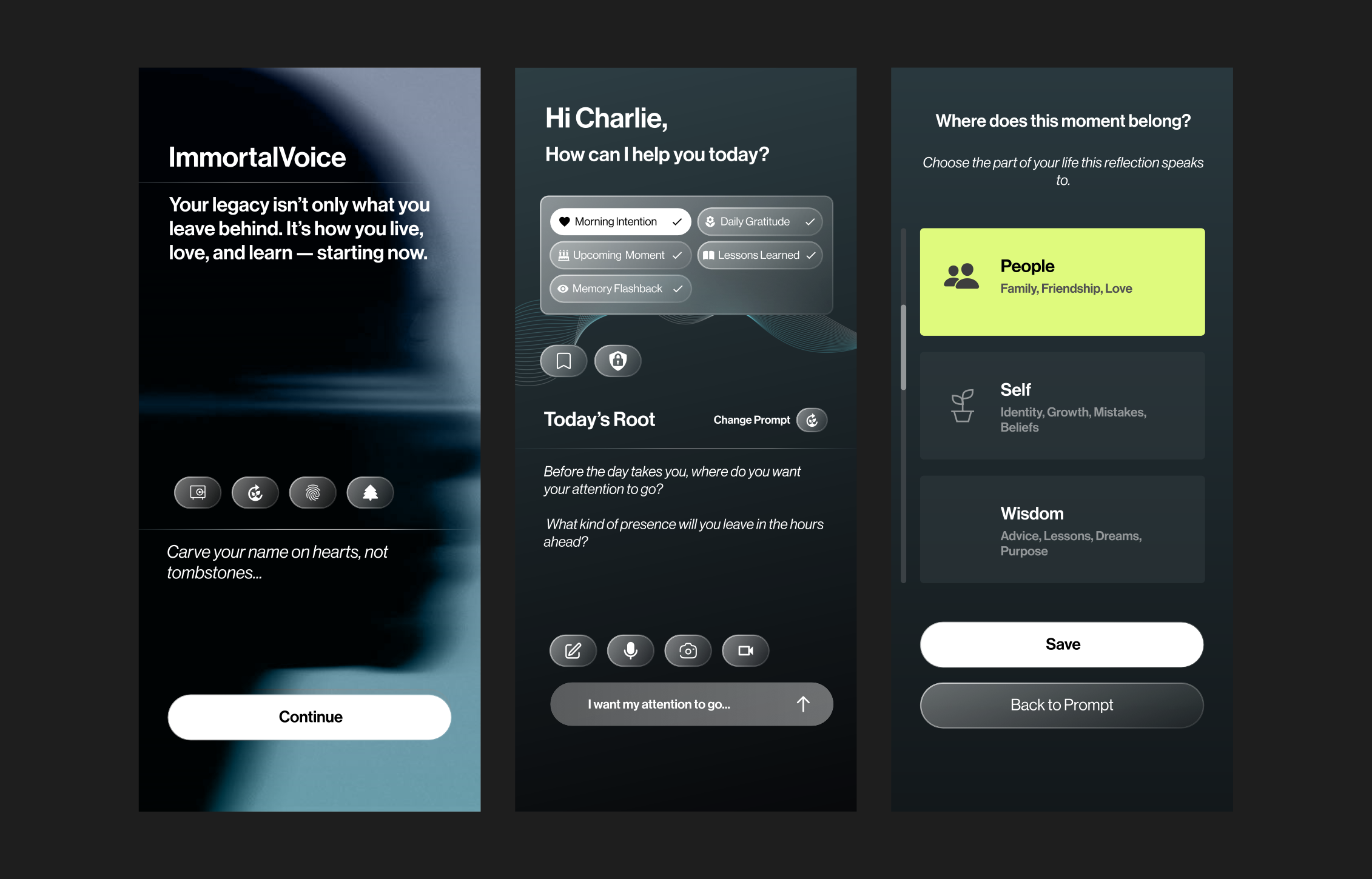
Recording Onboarding Flow
Relationship Selection:
→ Prompted Reflection
→ Voice Recording
→ Archive Placement
→ Revisit & Expand
Product Experience Design
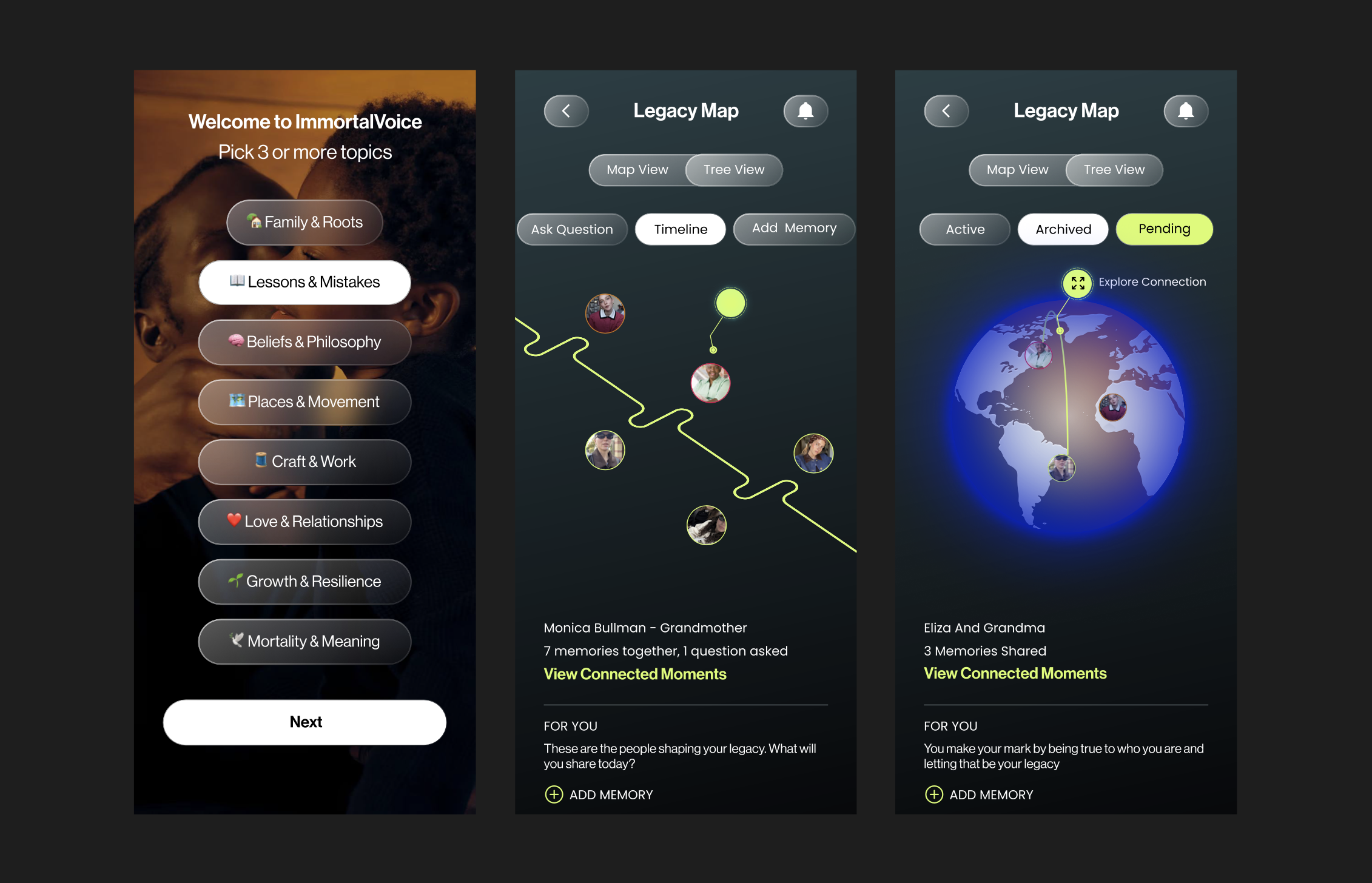
The MVP introduced relationship-based prompts to reduce hesitation associated with open-ended voice recording.
Memories were categorised by relationship (family, friendships, milestones) before capture to reduce cognitive load and support willingness to begin recording.
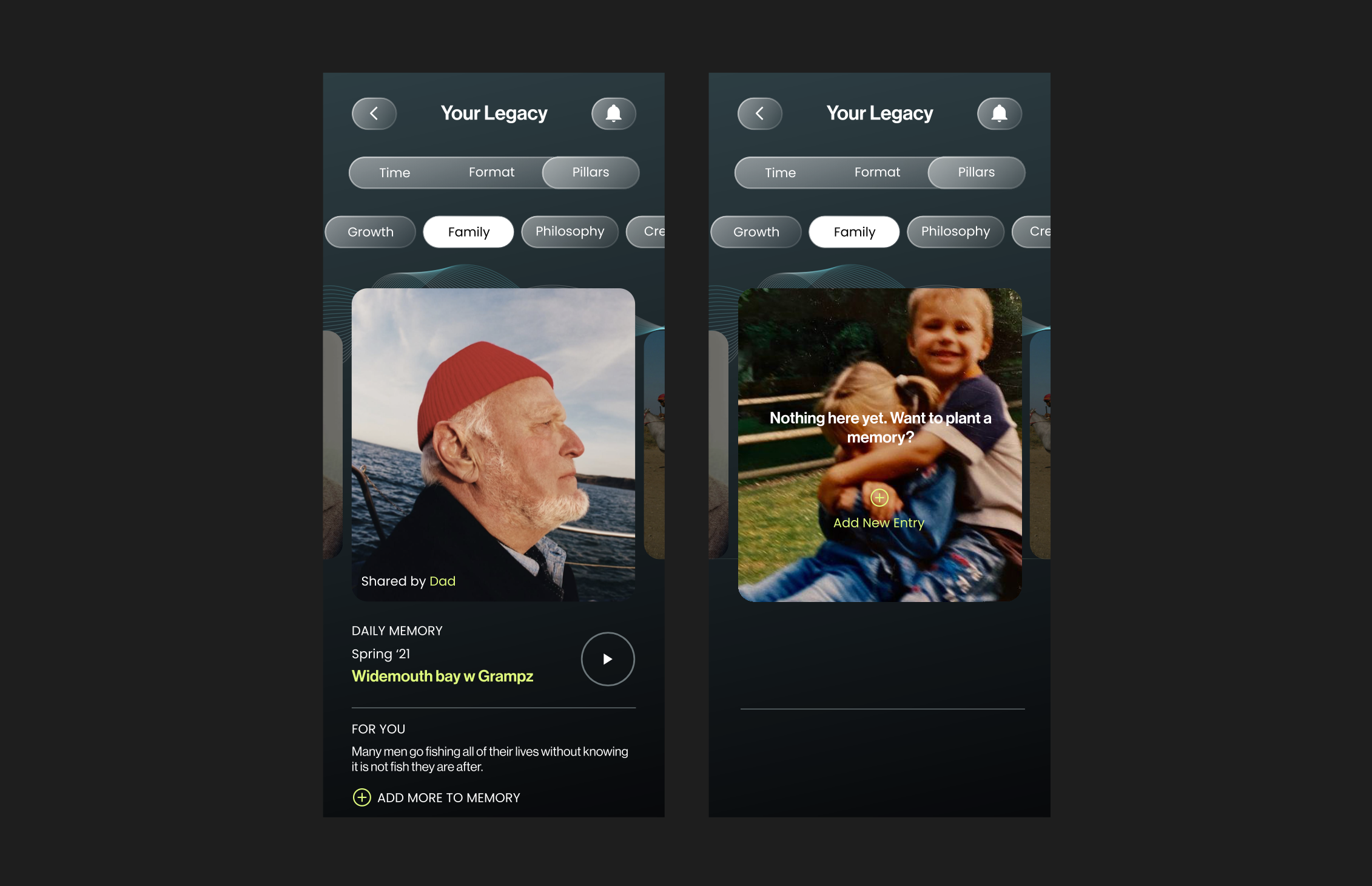
A spatial archive view was introduced over a timeline feed to visualise memory accumulation and reinforce long-term value.
Core interaction loop:
Prompt → Record → Archive → Revisit → Expand
Relationship-based prompts and archive visualisation were designed to support continued capture over time through milestone-based return behaviour.
MVP Constraints
The MVP prioritised validating first-time recording behaviour over archive management.
- Single-user voice capture only
- Fixed relationship categories
- No transcription
- Limited filtering
- No shared accounts
Interface complexity was minimised to support onboarding completion and successful first memory capture.
Validation Method
As the MVP was not taken to public release, interaction concepts were evaluated through moderated user walkthroughs.
Participants were asked to complete a first recording using guided relationship-based prompts while observing hesitation and onboarding completion behaviour.
Outcome & Learnings
Moderated walkthroughs suggested that participants were more comfortable beginning recordings when guided by relationship-based prompts rather than presented with an open interface.
Key learnings:
- Guided entry points reduce recording hesitation
- Relationship-led categorisation reduces decision fatigue
- Archive visualisation supports perceived long-term value
Future iterations would explore shared family accounts, automated transcription and contextual reminder prompts.